



Do you need a night light for baby? Not necessarily. At night, official guidance recommends sleeping in the dark; a small soft light is mostly useful for parents, for night feeds, bottles and changes. Here is how to choose a baby night light, use it at the right moment and install it safely.
In short: a night light is not essential, since the French health insurance (Assurance Maladie) recommends night-time sleep in the dark. If you use one, keep it for night-time care: a dim, warm light, switched on for the time of the care and then off (the Assurance Maladie advises against LED night lights for babies), placed out of reach, cable included, with a battery compartment closed by a screw.
Do you need a night light in baby's room?
When it comes to sleep, the guidance is simple. The Assurance Maladie recommends naps in natural light and night-time sleep in the dark, as well as daytime feeds in full light and night feeds in the dark, to help baby learn the difference between day and night. So baby does not need a light on to sleep.
The night light mostly helps the adults. When baby wakes, the French public health site 1000 premiers jours advises keeping the atmosphere calm, without noise or bright light: a very soft light lets you see for a change or a bottle without switching on the ceiling light. It can also be part of the evening ritual, since “switching on a small light” is among the habits listed by 1000 premiers jours.
Using a baby night light well, from evening to morning
- In the evening: lower the lights in the house, and the night light takes over during the ritual. All our pointers are in our baby bedtime routine, step by step.
- During the night: switched on at its lowest for a feed or a change, then switched off, or turned off by the timer.
- In the morning: open the shutters wide. According to 1000 premiers jours, this contrast between evening dimness and morning light gives cues to baby's developing rhythms.
- No screens: the blue light from phone or television screens can disturb baby's rhythms, and 1000 premiers jours advises avoiding it, especially in the evening and at night. Keep your phone aside during night-time care.
How to choose a night light for baby
No need for a sophisticated model. A few criteria are enough:
- A dim, warm light, ideally adjustable, just enough to see: an amber or orange shade suits this small role. Be careful with LEDs: the Assurance Maladie advises against night lights with LED light for babies, as they can disturb their sleep cycles, and the 1000 premiers jours site asks parents to avoid blue light. If your lamp is LED, switch it on only for the time of the care.
- A timer or automatic shut-off, handy so it is not left on all night.
- A model that does not heat up: baby must be kept away from hot objects, light bulbs included.
- A secured battery compartment, closed by a screw or a locking device, if it runs on batteries.
- The CE or NF marking, and warnings on the packaging read carefully.
- A decor object, not a toy: soft-toy night lights have no place in the cot, which must stay empty.
Plug-in, batteries or rechargeable? All three exist. A plug-in night light means keeping an eye on the cable; a battery model, its compartment; a rechargeable model is charged out of baby's reach, following the instructions. In every case, placement matters as much as the model.
Button batteries: the danger to know about before Christmas
Button batteries, those small flat round batteries, power many everyday objects. The French Ministry of Health lists night lights among the objects involved in ingestions reported to poison centres. If swallowed, a button battery can cause very serious complications, sometimes in under two hours, and even a flat one remains dangerous.
The right habits, according to the French Ministry of Health and Anses:
- store button batteries out of reach, new and used alike;
- check that the battery compartment does not open easily; if it does, keep the object out of baby's reach;
- choose devices whose compartment closes with a screw or a locking device.
In case of ingestion, even suspected, do not wait for symptoms: immediately call a poison centre or emergency services (15 or 112 in France, 112 in Belgium and the Netherlands), say that it may be a button battery, give nothing to eat or drink, do not induce vomiting, and keep the packaging or device to show them. Health authorities have called for particular vigilance at Christmas time.
Where to put the night light, and what about the cable?
- Out of baby's reach, never in the cot or hung on its bars: up high, on a chest of drawers or a shelf away from the cot, for example.
- The cable too: a hanging wire can be grabbed. The US Consumer Product Safety Commission (CPSC) advises keeping baby monitors and cords at least 3 feet from the cot, about 90 cm, to limit the risk of strangulation. Le Bonheur Children's Hospital in the United States also advises not placing the cot near electrical cords.
- Protected sockets: socket covers, and no extension leads left plugged in. As soon as they crawl, babies are drawn to sockets and trailing wires, as 1000 premiers jours points out.
The same reasoning applies to the baby monitor: never in the cot, not too close to baby, switched off when not in use. Find all the other points in our nursery safety checklist.
Alternatives to a night light
Not sure? Other solutions exist, without adding anything to the room:
- The door ajar onto a dimly lit hallway, for the time of the care.
- A dimmable lamp, set to its lowest and placed out of reach.
- Complete darkness, quite simply, if you can find your way without light.
- A sound ritual rather than a light one: a lullaby, or a wind-up music box placed out of reach, which can accompany the evening ritual.
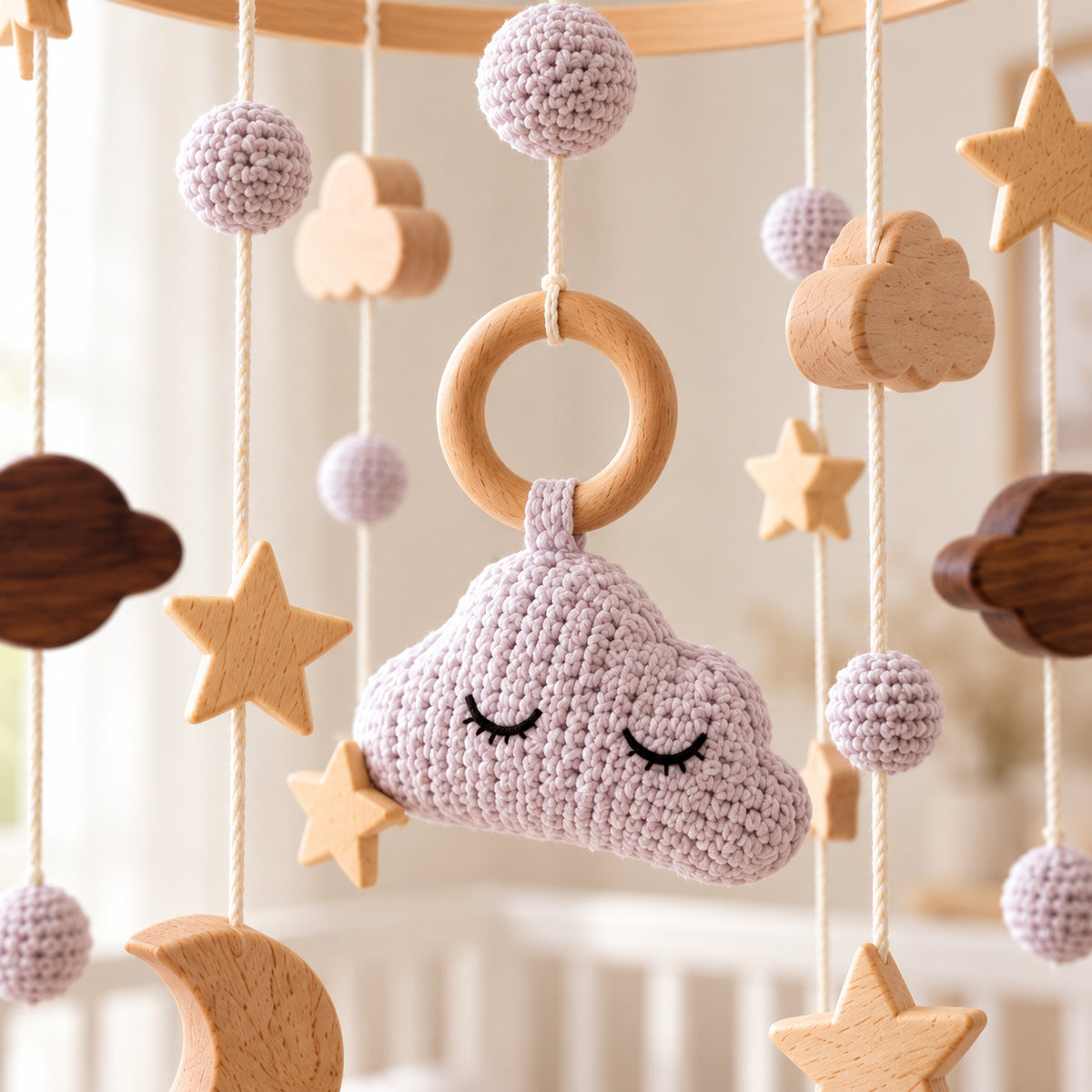
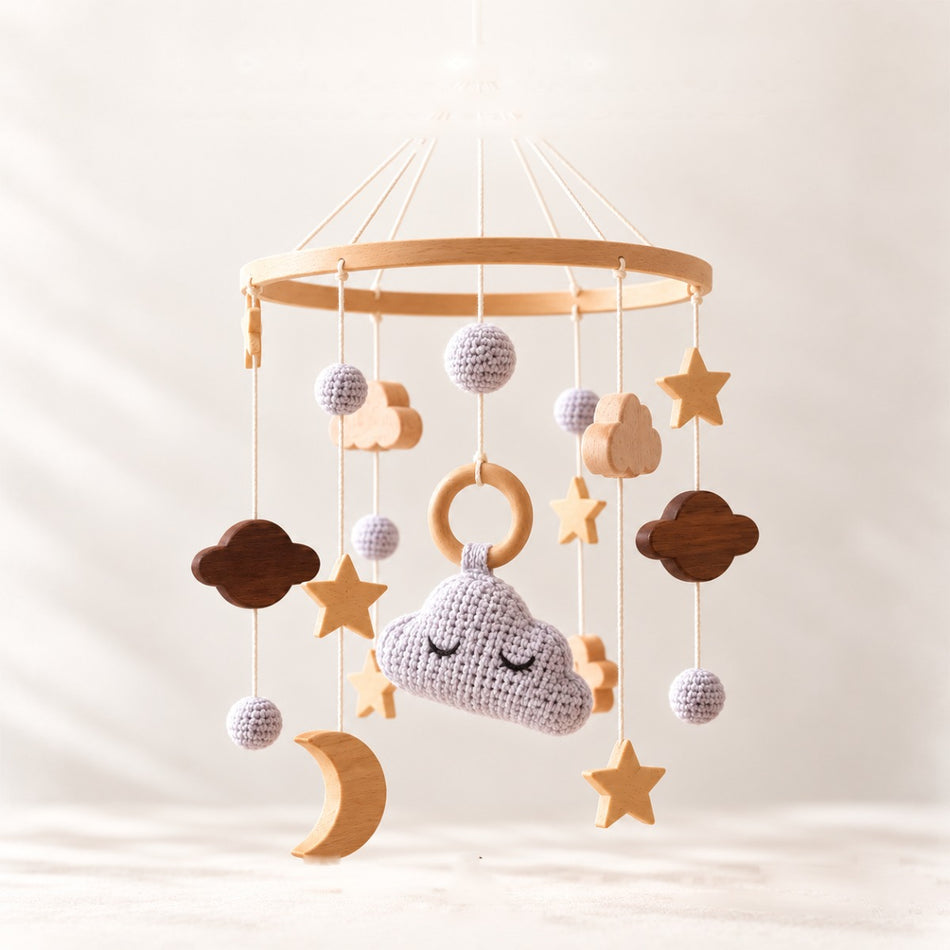
And for visual softness, rely on decor rather than light: a moon, a few clouds, stars on the wall. Our ideas are gathered in our article sky-themed nursery: moon, clouds and stars.
FAQ: baby night lights, your questions
Should the night light stay on all night?
It is not necessary: the Assurance Maladie recommends night-time sleep in the dark. Switch it on for the ritual or night-time care, then switch it off, or let the timer do it.
What colour of light for a baby night light?
The Assurance Maladie advises against LED night lights for babies, and 1000 premiers jours asks parents to avoid blue light. For night-time care, choose a dim, warm light, amber or orange, just enough to see, then switch it off.
Battery or rechargeable night light?
Both can work. For a battery model, choose a compartment closed with a screw, especially if it uses button batteries. A rechargeable model is charged out of baby's reach, following the instructions.
Where should the night light go in baby's room?
Out of reach, never in the cot, with a cable that does not hang down: up high, on a piece of furniture away from the cot. Accessible sockets stay protected with socket covers.
Can a soft-toy night light stay in the cot?
No. For sleep, baby's cot stays empty, with no soft toy, comforter or cushion, as the recommendations relayed by Santé publique France state. Place it outside the cot and out of reach.
To accompany the evening ritual without screens or bright light, discover our music boxes, such as our white wind-up music box, to hang out of baby's reach. Delivery is free to mainland France, Belgium and the Netherlands.
Sources (in French unless stated): Assurance Maladie: how to put a baby to bed safely; Assurance Maladie: healthy habits for good sleep; Santé publique France, 1000 premiers jours: baby's sleep (on Santé.fr); Ministry of Health: button batteries and young children (on Santé.fr); Anses: button batteries, preventing ingestion; Santé publique France, 1000 premiers jours: preventing household accidents (on Santé.fr); Santé publique France: sudden unexpected infant death; CPSC: Safer Spaces for Baby (English); Le Bonheur Children's Hospital: Crib Safety (English).
0 comments