


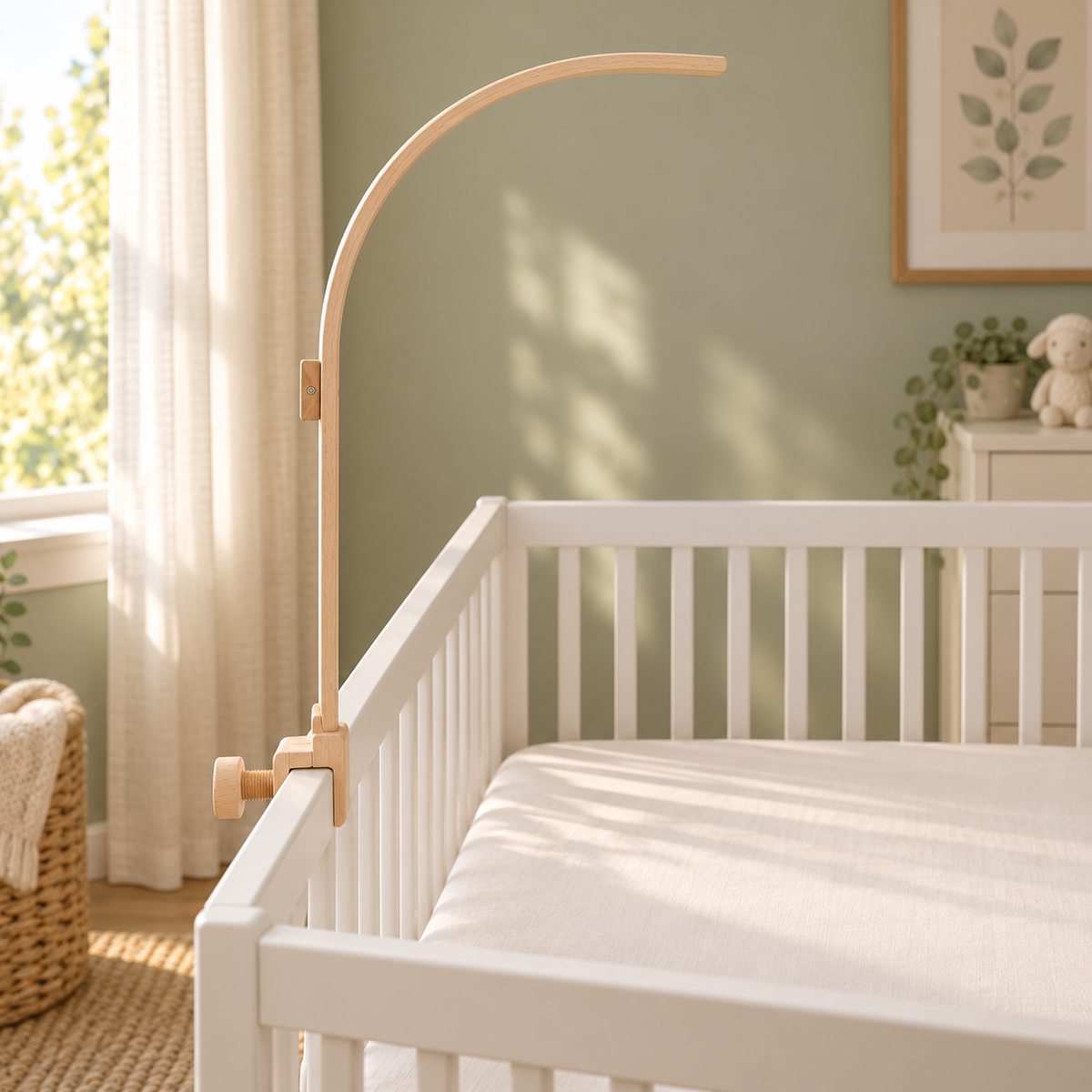

A safe nursery is not an austere one: it is a room where every detail has been checked calmly, so that you can then simply enjoy it. Here is our safety checklist, zone by zone, based on official French recommendations (Santé publique France, the French health insurance Assurance Maladie and the 1000 premiers jours site).
In short: baby sleeps on their back, in a sleeping bag of the right size, on a firm mattress, in an empty cot, in a room at 18 to 20 °C, and in your room for at least the first six months. Around the cot: furniture fixed to the wall, nothing climbable under the windows, cords and cables kept away, socket covers, button batteries out of reach, a mobile securely attached and out of reach.
Baby's sleep: the official safety rules
This is the most important zone. Santé publique France points out that sleeping on the tummy or side is the major risk factor for sudden unexpected infant death, and that objects in the cot increase the risk of baby's face becoming covered. The guidelines:
- On their back, flat, at night as for every nap. Once they can roll over on their own, do not force them to stay on their back, but keep putting them down that way.
- In a sleeping bag suited to their size and the season, with no sheet or duvet on top. Avoid piling on layers of clothing, and put your hand on the back of their neck: if it is damp, they are too warm.
- On a firm mattress, sized to the cot, with a fitted sheet of the right size. In a travel cot, do not add a second mattress.
- In an empty cot: no cushion, pillow, duvet, blanket, bumper, sleep positioner, comforter or soft toy.
- In a compliant cot, with the CE or NF marking and a statement that it meets safety requirements. For a cot with bars, the Assurance Maladie gives a spacing of 4.5 to 6.5 cm, according to the European standard. Unpack a new cot early, so it has time to air.
- In your room, in their own cot, for at least the first six months, or even the first year. No sharing the parents' bed, and do not fall asleep with them on a sofa or armchair. The infant car seat is for the car only.
- No ties and no heat: never a necklace or cord for the dummy, never a hot water bottle in the cot.
Using a bedside cot attached to yours? Attach it firmly, with no gap, and apply exactly the same sleep rules. We cover this case in detail in our article mobile for a bedside cot: installing it safely.
Temperature, air and light in the nursery
- 18 to 20 °C: a room that is not overheated, with air circulating. A small room thermometer lets you check at a glance.
- Aired every day, and smoke-free: do not smoke in the room where baby sleeps, and do not let anyone smoke near them.
- Naps in natural light, nights in the dark, as the Assurance Maladie advises.
- No pets in the room: the Assurance Maladie advises not letting the family pet in, and 1000 premiers jours never to leave baby alone with an animal, even a very familiar one.
A well-set room is also the ideal setting for the evening routine. For the gestures themselves, follow our baby bedtime routine, step by step.
Mobile and decor: pretty, but out of reach
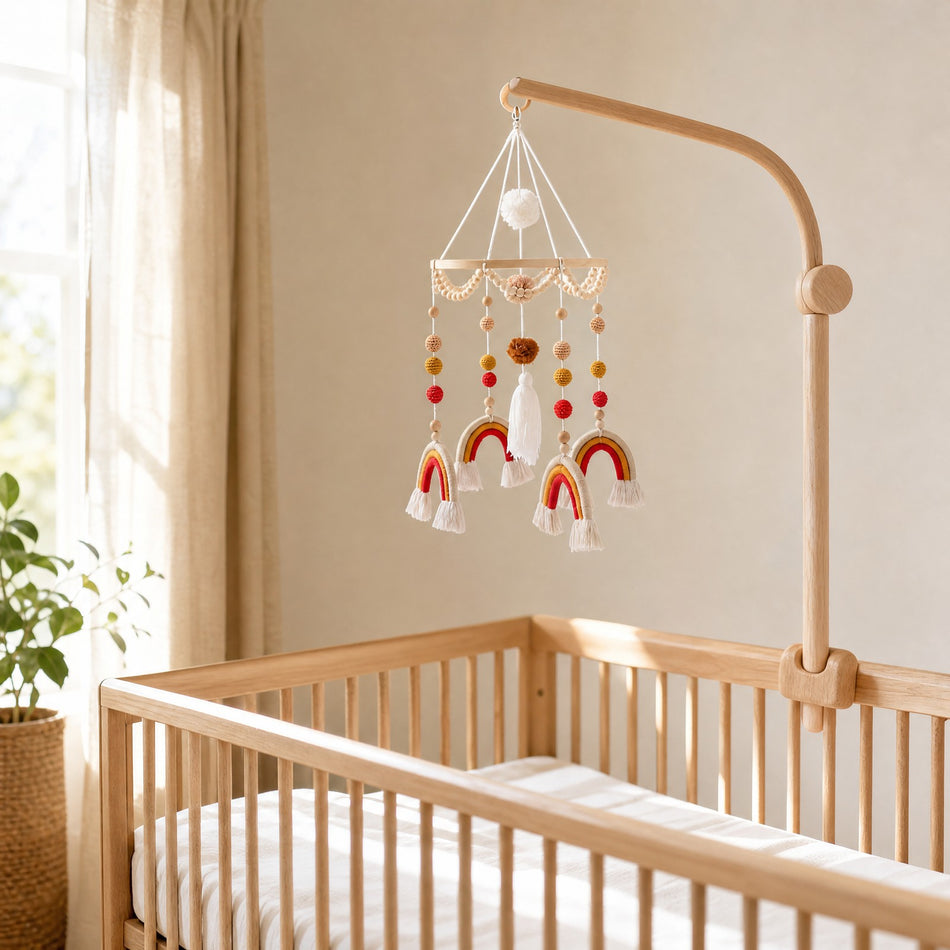
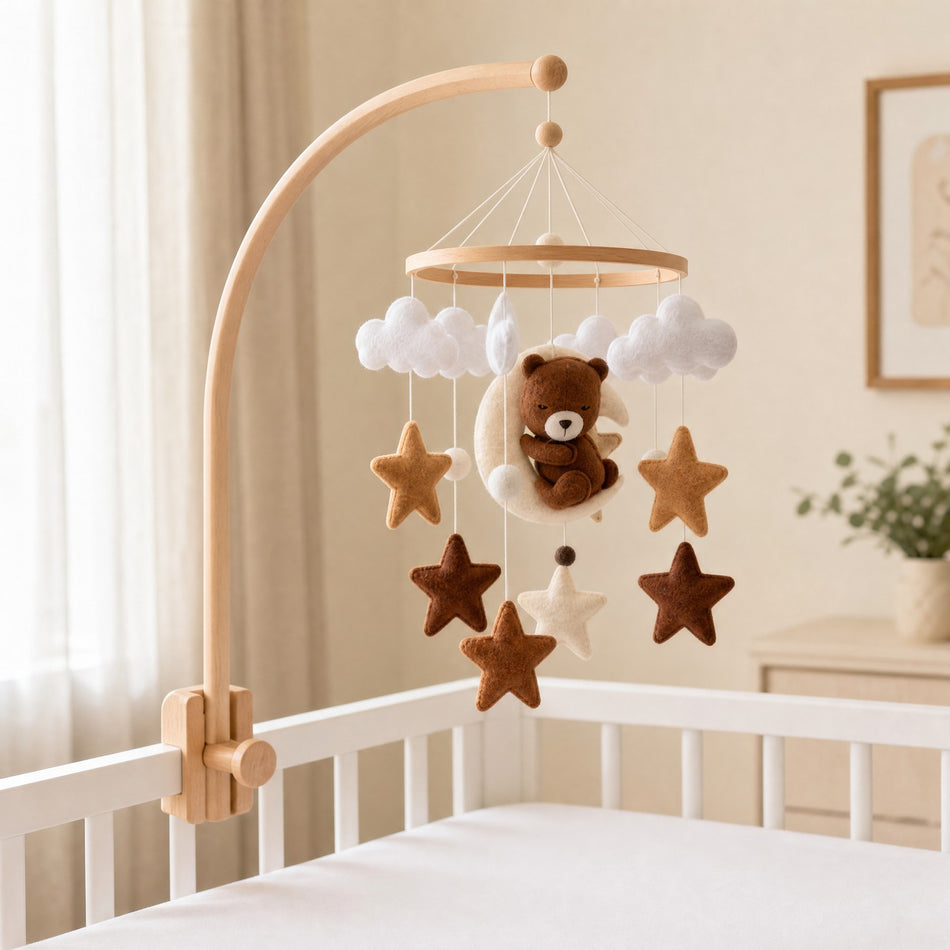
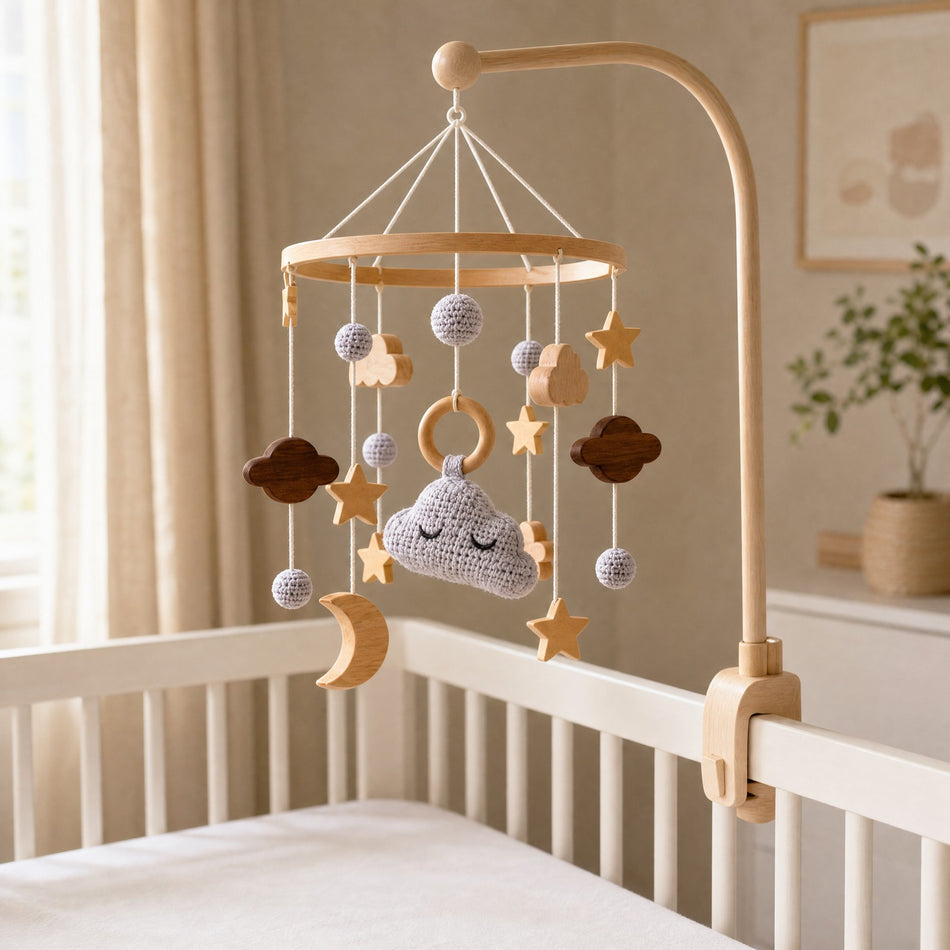
A mobile is for looking at: it always stays out of baby's reach. If you install one, the Assurance Maladie asks that it be perfectly secured and that baby cannot reach it. The guidelines we apply:
- hung out of reach, even with arms stretched out, with nothing hanging into the cot;
- attachment checked regularly: clamp tight, arm stable, hook solid;
- removed from above the cot as soon as baby starts to push up on hands and knees, or at around 5 months, whichever comes first, because of the strangulation risk (this is also the guidance of Le Bonheur Children's Hospital in the United States);
- afterwards, it can stay in the room as decoration, away from the cot and out of reach.
Another official recommendation is worth knowing. To help prevent flat head syndrome (plagiocephaly), the Assurance Maladie advises avoiding arches and mobiles that hold baby's attention upwards without any neck movement, and offering colourful, sound-making toys placed around them. The mobile therefore remains a pretty decoration to look at from time to time; awake time is spent mostly in your arms, or on a play mat, on their tummy and under constant supervision. For attaching it, see how to install a baby mobile; for when to remove it, our article baby mobile: until what age.
For the rest of the decor, position the cot so that any dangerous object stays out of reach, do not hang frames or shelves above it, and keep fairy lights and cables away from the cot. Before buying a houseplant, ask a professional: some are toxic if baby puts them in their mouth.
Furniture, windows, cords: making the nursery safe
- Furniture fixed to the wall: chest of drawers, bookcase, wardrobe. As soon as they start moving, baby may want to climb them. Also consider drawer safety kits, against pinched fingers.
- Always a hand on baby on the changing table. Need to fetch something? Take them with you, or put them down safely in their cot or on the floor.
- Nothing under the windows that they could climb: no furniture, chest or pouffe. Window safety devices exist, and never leave a child unsupervised near an open window or on a balcony.
- Curtain and blind cords kept at a distance: move the crib, cot and furniture away from these cords. Strangulation can happen quickly and silently.
- Nothing around the neck: no necklace (including amber or teething necklaces), chain, scarf or clothing cord.
Sockets, baby monitor, night light and button batteries
- Socket covers on accessible sockets, and no extension leads left plugged in: once they crawl, babies are drawn to sockets and trailing wires.
- Baby monitor kept away: never in the cot or too close to baby, switched off when not in use. The US Consumer Product Safety Commission (CPSC) advises keeping baby monitors and their cords at least 3 feet from the cot, about 90 cm.
- A soft night light out of reach, cable included. The Assurance Maladie advises against LED night lights for babies, and the 1000 premiers jours site asks parents to avoid blue light.
- Button batteries out of reach, new and used alike: even a flat button battery is dangerous if swallowed. The French Ministry of Health lists night lights among the objects involved, and Anses advises choosing devices whose battery compartment closes with a screw.
- Small objects put away: small toys, buttons, jewellery, small parts of soft toys, plastic bags. As they grow, babies grab objects and put them in their mouths.
If a button battery is swallowed, even suspected: call a poison centre or emergency services immediately (15 in France, 112 in Belgium and the Netherlands), say that it may be a button battery, give nothing to eat or drink, do not induce vomiting, and keep the packaging or device to show them. Every minute counts.
FAQ: nursery safety
What temperature for baby's room?
18 to 20 °C, according to Santé publique France, the Assurance Maladie and 1000 premiers jours. Air the room every day and dress baby in a sleeping bag suited to the season, without piling on layers.
Until when does baby sleep in the parents' room?
For at least the first six months, in their own cot, and even up to one year according to the recommendations relayed by Santé publique France. After six months, 1000 premiers jours says they can also sleep in another room, if your home allows.
Do you need a cot bumper?
No. The Assurance Maladie says bumpers are not recommended, and Santé publique France lists them among the objects to keep out of the cot, along with cushions, duvets, pillows and sleep positioners.
Can baby sleep with their comforter?
Official guidance varies. The recommendations relayed by Santé publique France exclude comforters and soft toys from the cot, and 1000 premiers jours specifies that before six months, no comforter should be nearby. The Assurance Maladie asks that, if a comforter is used, it carries the NF standard and is suitable for under-36-months. The safest option remains an empty cot.
When should furniture be fixed to the wall?
Ideally as soon as you set up the room, before baby starts moving around: that is when, as 1000 premiers jours points out, they may want to climb a chest of drawers or a bookcase.
A safe room can still be a soft one. To hang a stable mobile, out of reach, discover our mobile arms, chosen with care.
Sources (in French unless stated): Santé publique France: sudden unexpected infant death; Assurance Maladie: how to put a baby to bed safely; Assurance Maladie: healthy habits for good sleep; Santé publique France, 1000 premiers jours: baby's sleep (on Santé.fr); Santé publique France, 1000 premiers jours: preventing household accidents (on Santé.fr); Santé publique France: preventing falls from windows; Ministry of Health: button batteries and young children (on Santé.fr); Anses: button batteries, preventing ingestion; CPSC: Safer Spaces for Baby (English); Le Bonheur Children's Hospital: Crib Safety (English).

0 comments